

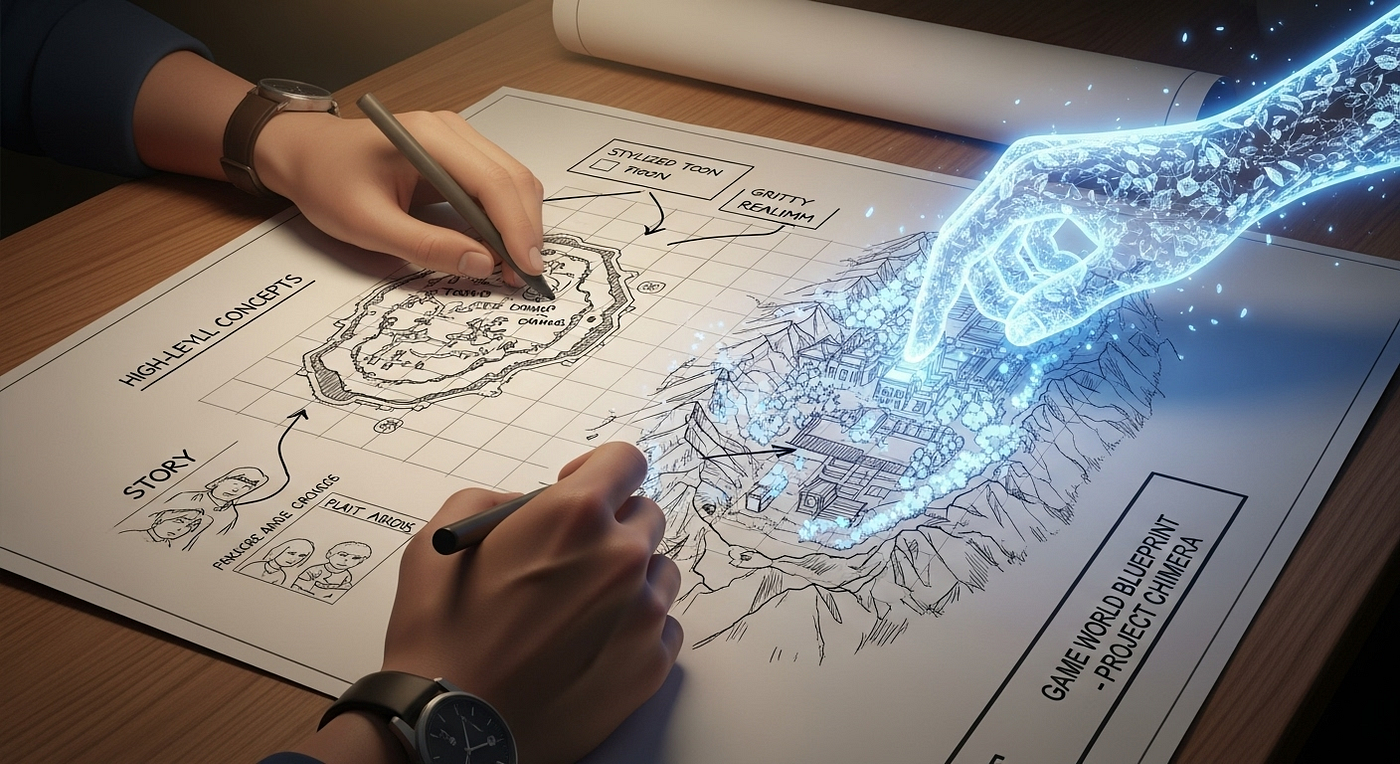
Imagine a world where video games never feel repetitive, where every time you press “start,” a completely fresh and unique experience awaits you. For decades, game developers have grappled with the challenge of creating content that keeps players engaged for long periods. Endless hours of development, painstaking level design, and testing often lead to diminishing returns—players explore every corner of a game and eventually move on to something else. But what if the game could evolve continuously, generating new worlds, challenges, and experiences on the fly? Welcome to the revolutionary domain of AI-generated game levels, a frontier that promises infinite replayability and a paradigm shift in how we play, design, and even think about games. This isn’t just a futuristic idea; it’s happening now, and it’s set to transform the gaming industry as we know it.
The Pain Points of Traditional Game Design
Creating levels in traditional game development is both an art and a grueling process. Designers spend weeks, sometimes months, meticulously crafting every nook, obstacle, and puzzle to ensure the player has a coherent, enjoyable experience. But no matter how innovative a game is, static levels come with inherent limitations. Once a player completes a level, the experience can’t change. There’s no room for spontaneity, and replayability is often tied to minor variations or secret achievements. This is where many games lose players, even those with rich storytelling or high-quality graphics. A slot game, for instance, relies heavily on the thrill of randomness, yet even the most expertly designed machine can feel predictable after a while. Similarly, adventure or puzzle games with fixed levels can feel repetitive, leading to player fatigue and a sharp decline in engagement over time. AI-generated levels aim to solve this by introducing an element of endless unpredictability, keeping players constantly curious and invested.
How AI Generates Game Levels
At its core, AI-generated content relies on advanced algorithms capable of learning and improvising. Procedural generation has been around for a while—think of the randomly generated worlds of Minecraft or the roguelike dungeons of Spelunky. However, these systems are relatively limited and often require predefined rules, leaving creativity constrained. Modern AI, particularly deep learning models and generative networks, takes procedural generation to a whole new level. These systems analyze thousands of existing levels, player behaviors, and design patterns to create new, coherent game spaces that feel handcrafted but are entirely unique each time. Unlike traditional level design, AI can optimize difficulty, balance gameplay, and even adapt to individual players’ skill levels in real-time, offering a tailored experience for everyone. This flexibility doesn’t just save developers time—it fundamentally changes the player’s relationship with the game. Every session feels fresh, every challenge unpredictable, and every victory satisfying because it’s earned in a world that may never be replicated.
Personalization: Playing to the Player’s Style
One of the most fascinating benefits of AI-generated levels is personalization. No two players interact with a game in the same way, yet most games present a one-size-fits-all challenge. AI changes that by dynamically adapting environments to match the player’s skills, preferences, and playstyle. For example, if a player tends to favor exploration over combat, AI can generate larger, intricate worlds filled with hidden treasures and puzzles rather than endless battles. Conversely, action-oriented players might encounter high-intensity challenges designed to test reflexes and strategy. This adaptive approach keeps players engaged far longer than static content ever could. Consider card-based games: while a qq poker game may rely on standard mechanics, AI could dynamically create tournaments or challenges that simulate human-like opponent behavior, making each session feel unpredictable and thrilling. The ability to cater to individual preferences turns games into deeply personal experiences rather than generic entertainment, which could redefine how loyalty and engagement are measured in gaming.
Breaking Free from Content Limitations
Traditional games often face constraints due to budget, time, or human creativity. Designers can only create so many levels before production costs escalate or inspiration runs dry. AI-generated game levels break these limitations by offering near-infinite variety. Developers no longer need to painstakingly craft hundreds of maps or environments manually—AI can do it in seconds. This is particularly transformative for mobile and online games, where players expect regular updates and new content to stay engaged. Imagine a world where every new login presents a completely different city to explore, dungeon to conquer, or island to survive on. The sense of novelty and surprise keeps players invested far longer than static design ever could. Furthermore, AI allows developers to experiment with highly creative and unconventional designs that might be too risky or resource-intensive to implement manually. This opens the door to genres and gameplay mechanics that were previously unfeasible, potentially sparking a renaissance in game innovation.
Enhancing Social and Competitive Gaming
AI-generated levels are not just a boon for solo players—they can also revolutionize multiplayer and competitive gaming. In traditional setups, tournaments and leaderboards are limited by the static nature of the game environment. Players quickly memorize maps, exploits, or optimal strategies, reducing the challenge and excitement of competition. With AI, each match can present new arenas, obstacles, and objectives, ensuring that mastery requires adaptability rather than rote memorization. This approach can be particularly exciting in online gaming communities, where content fatigue is a major issue. Consider how dynamic AI-generated maps could invigorate a slot game or a poker game tournament by creating unique scenarios or game variants that test players’ strategic thinking in unexpected ways. By keeping the competitive landscape constantly evolving, AI can foster a more dynamic and engaging ecosystem for players and viewers alike, transforming the way esports and online tournaments are experienced.
The Role of Machine Learning in Player Retention
Player retention is a critical challenge in the gaming industry. Even the most popular games struggle to keep users engaged beyond the initial excitement. AI addresses this through predictive modeling and machine learning. By analyzing vast amounts of player data, AI can anticipate what kinds of levels or challenges are likely to resonate with specific audiences. This allows developers to introduce content that is not only surprising and engaging but also tailored to increase retention. For example, AI could detect when a player is becoming frustrated with a difficult level and dynamically generate a slightly easier challenge to maintain engagement without compromising the sense of achievement. Alternatively, for highly skilled players, AI can introduce additional complexity to keep them invested. This level of responsiveness is impossible in traditional static game design, making AI a powerful tool for cultivating long-term player loyalty.
Economic and Development Implications
The adoption of AI-generated levels also has profound economic implications. By automating a significant portion of the design process, studios can reduce development costs and time-to-market for new games. Smaller indie studios can compete with AAA developers by leveraging AI to produce high-quality, expansive worlds without the need for large design teams. Additionally, AI-generated content opens opportunities for microtransactions and DLC in innovative ways. Instead of selling pre-designed expansions, developers could offer “content packs” where AI generates custom levels or challenges on demand. This creates a sustainable model for ongoing revenue while keeping the player experience fresh and exciting. Moreover, the ability to generate content continuously could reduce the pressure to release sequels frequently, as a single game could evolve indefinitely, providing an ever-expanding universe for players to explore.
Addressing the Potential Challenges
Of course, AI-generated game levels are not without their challenges. Maintaining quality control and coherence is crucial; a poorly generated level can frustrate players rather than delight them. Developers must carefully balance procedural creativity with gameplay integrity, ensuring that AI does not compromise the core experience. Ethical considerations also arise regarding content moderation and player data usage. AI systems rely heavily on large datasets, which must be handled responsibly to protect user privacy. Additionally, there is the risk that AI-generated content could reduce the role of human creativity in game design, potentially leading to homogenized experiences if not managed carefully. However, when implemented thoughtfully, AI acts as a collaborator rather than a replacement, amplifying the creative potential of human designers while addressing many of the limitations of traditional methods.
Looking Ahead: Infinite Replayability as the New Standard
The most exciting aspect of AI-generated game levels is the potential to redefine replayability entirely. No longer do players need to rely on pre-designed content, expansions, or community mods to extend the lifespan of a game. AI allows games to be living, evolving experiences that respond to player behavior, skill, and preference. This could fundamentally shift how we think about gaming as an industry—from one-time purchases to ongoing, adaptive entertainment ecosystems. Imagine logging into your favorite game and discovering entirely new worlds, challenges, and narratives that no other player has ever seen. For genres as varied as RPGs, shooters, puzzle games, sultanslot game, or even competitive poker game, this could usher in a golden era of engagement, creativity, and personalized fun. AI is not just a tool; it’s a partner in crafting the future of infinite replayability, and the possibilities are limited only by our imagination.
Conclusion
AI-generated game levels are more than a technological novelty—they represent a fundamental shift in how games are designed, experienced, and monetized. By addressing the pain points of traditional game design, offering personalized and adaptive gameplay, and unlocking infinite replayability, AI has the potential to redefine player engagement across genres. From solo adventures to competitive multiplayer arenas, AI can create worlds that are endlessly dynamic, challenging, and rewarding. While there are challenges to navigate, the benefits are transformative, promising a future where games remain perpetually exciting, personal, and immersive. As we look ahead, the era of static levels is fading, and a new age of dynamic, AI-generated gaming experiences is dawning—a future where every session is a fresh adventure, and the boundaries of imagination are limitless.